
The Campus' First Expansion
The campus was organized, in general conformity with Joseph Henry's Campus Plan, into an open quadrangle plan with a central axis and clear hierarchy, leaving Nassau Hall as the largest and most central structure. While delineating a new communal space for the College, the new back campus quadrangle also reflected the high value placed on the preservation of landscape openness by maintaining generous spaces between buildings.
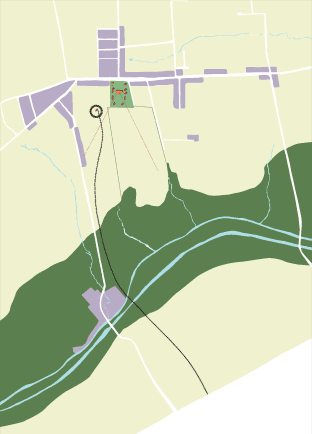
The town of Princeton continued to expand outward from Nassau Street as well as in the Princeton Basin area with hotels, offices, loading basins, and factories dependent on the canal and railroad. Princeton developed from the place for an overnight stay to a commuter village, with relatively easy access to Philadelphia and New York.

"It was as much a state of mind as an architectural style, charged with connotations of Athenian democracy, purity, wisdom, and independence."
As quoted in "Campus; An American Planning Tradition", Paul Venable Turner, p.90


Images: Graphic Arts Collection and University Archives, Department of Rare Books and Special Collections, Princeton University Library. Courtesy of The Historical Society of Princeton.
Photos: Courtesy of the Princeton University Office of Communications.
© 2006 The Trustees of Princeton University Last update: November 2, 2006