
Rapid Growth and Expansion
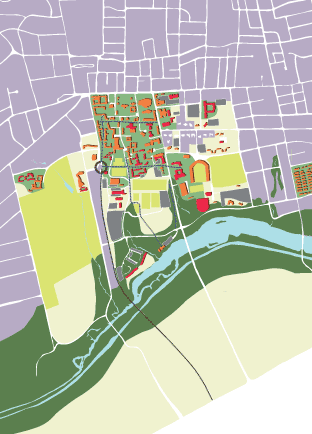
The combined effects of the Great Depression and World War II resulted in a 14-year building hiatus at Princeton (1933-1947). Due largely to increased government funding for laboratory buildings, a major and rapid campus expansion occurred in the 1960s. This growth pushed the campus boundary farther to the south and located major academic facilities east of Washington Road. By 1951 Collegiate Gothic was no longer the official architectural style "due to cost and other factors" and the University, like Oxford, Cambridge, and other American universities, intended to build in a "contemporary" style.

Contemporary is not to mean a "show-stopper, a striking design in the most extreme fashion" but is to "seek to preserve within the modern idiom the overall design of the campus" and continue the "'very human' scale... dominated by nature."
Douglass Orr, Princeton Alumni Weekly, May 20, 1960, p.8
"The university... is a growing organism whose form lies partly in the past, partly in the future..."
Joseph Hudnut


Images: Graphic Arts Collection and University Archives, Department of Rare Books and Special Collections, Princeton University Library. Courtesy of The Historical Society of Princeton.
Photos: Courtesy of the Princeton University Office of Communications.
© 2006 The Trustees of Princeton University Last update: November 2, 2006